You understand the 5×5 pieces and can read 3×3 face turns.
Keep one front fixed. Judge turn direction by looking directly at the named face.
1. Outer turns move one face layer
R, U, and F mean the same thing as on a 3×3: turn only the outer layer. Apostrophes reverse quarter-turns; a final 2 makes a half-turn. These are the moves you will use after reduction.
2. Wide turns move neighboring layers together
Rw means the outer right layer and its neighboring inner layer together. Uw is the top two layers together. Lw is the left two. The w stands for wide.
3Rw means the rightmost three layers together. Only a written leading 3 changes the width to three; ordinary Rw still means two layers.
3. Inner turns exclude the outer face
2R means only the second layer counted from the right. It does not include the outer right face. 2R2 turns that single inner slice 180°.
| Move | Layers | Amount |
|---|---|---|
R2 |
Outer right only | 180° |
Rw |
Rightmost two together | 90° clockwise |
Rw' |
Rightmost two together | 90° counterclockwise |
2R2 |
Second from right only | 180° |
The leading number chooses a layer or width; the trailing 2 chooses the amount of turn. Read both ends of the token before moving.
4. Whole-cube rotations change your grip
x rotates the entire cube in the direction of R: the old front becomes the new top. y rotates the entire cube like U. These rotations keep pieces together but change which face the following letters refer to.
The parity player physically shows x. Follow the new front and top afterward. In the turning drill below, every move is followed by its inverse so you can check the layer width without losing the start.
Watch, then try
Work through an example
Use one move at a time first. This prepared case teaches a specific action; use the lesson’s setup instructions to recognize when it applies to your own scramble.
Watch one worked example
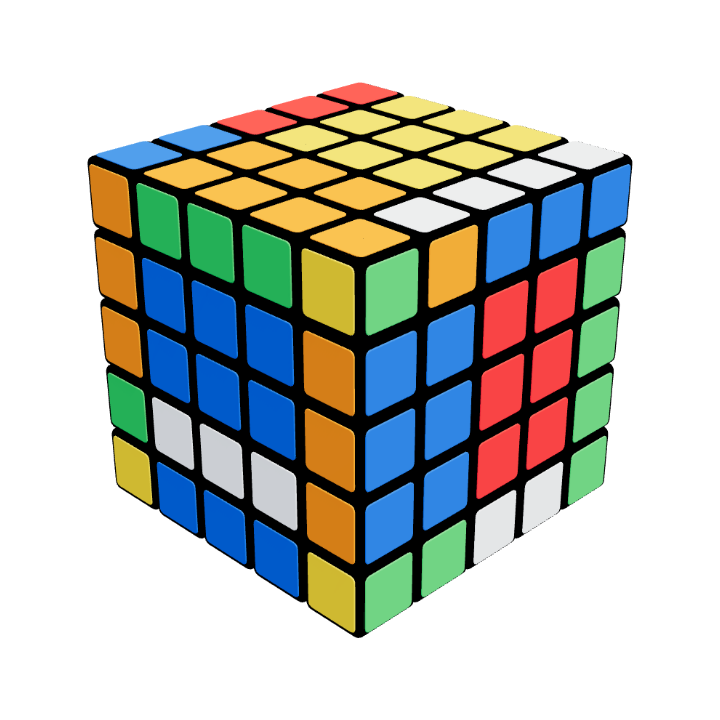
Each turn is followed by its inverse. Watch which interior stickers move for Rw and 2R; the two moves do not turn the same layers.
Example grip: yellow up · blue front · red right at the start. Follow any written whole-cube rotations.
0 / 8
Loading 3D cube…
Prepared position · 0 / 8 moves
Use Next move to follow the sequence.
Drag to inspect other faces. Arrow keys rotate the view when the cube is focused.
Copy this exact example on your own cube
Start with a solved 5×5, yellow up and blue front. Apply the setup below from left to right. This creates the example’s starting position. Keep this separate from the ongoing scramble you are solving through the course.
R U R' F2 D L2 B U2 Rw U FwThen follow the lesson sequence. If your cube’s color scheme differs, match the piece relationships using your own colors.
Compare the starting position and the result
Drag each cube to inspect its other faces.
Explain it to yourself
Check your understanding
Now use your own cube
Your turn
Perform each move followed by its inverse. Count the layers with a finger before turning: R, Rw, 2R, and 3Rw.
Open a 5×5 Digital Cube for practiceOpens in a new tab so you can keep this lesson beside your practice. Check the lesson goal yourself; the Digital Cube does not grade it.
If you get stuck
My center pieces break when following parity.
Check layer widths first. R, Rw, and 2R are different. During x, rotate the whole cube and use the new face directions afterward.
Before moving on
Check your result
Preparation · no solving yet
Return to the same scramble
Practice the difference between one inner layer, two wide layers, and three wide layers, undoing each move. The cube stays scrambled; begin solving the centers next.
Confirm these on your cube. Watching the animation alone does not complete the lesson.
Check every item when you can do it yourself.