You can solve the last layer using the beginner method, and your cube has a yellow cross.
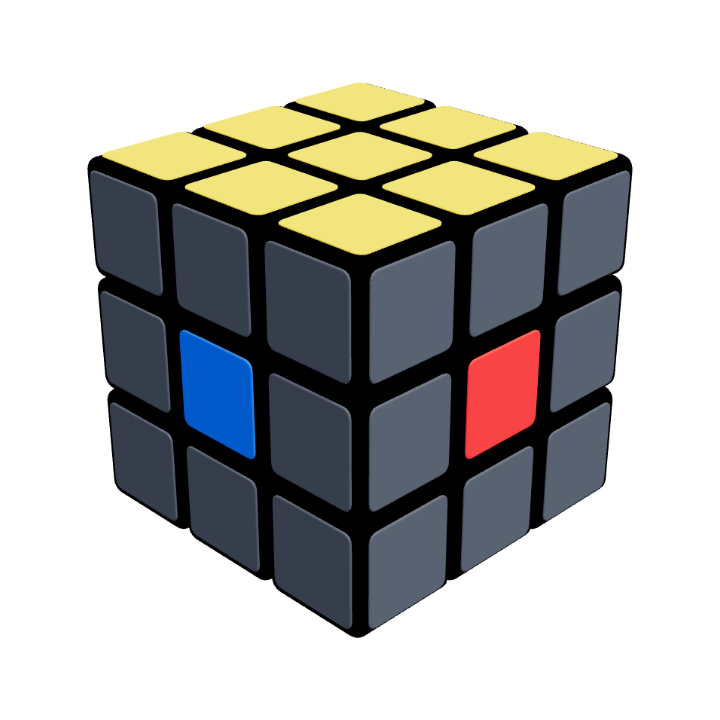
Keep yellow up. The only corner with yellow facing up is at top-front-left. The top-front-right corner has yellow facing forward.
1. Understand what this case teaches
OLL means orienting the last layer so the whole top is one colour. You already do this by making the yellow cross and then twisting the corners. This lesson adds one faster corner case to use after completing the cross.
Do not apply Sune to every mixed yellow face. The recognition and orientation below are part of the algorithm.
2. Check both identifying stickers
First make sure all four yellow edges face up and the first two layers are solved. Then inspect the corners:
- Exactly one corner has yellow facing up. Hold it at top-front-left.
- The corner at top-front-right has its yellow sticker facing front.
The second condition distinguishes this case from a similar-looking opposite twist. Compare both conditions with the starting net below before turning.
3. Apply Sune
R U R' U R U2 R'
Perform all seven moves without changing your grip. With the correct setup, the top becomes yellow and the first two layers stay solved. The top-layer pieces may still need to be permuted to match the side colours.
4. Use a familiar fallback for other cases
If your top does not match these conditions, use the beginner yellow-corner method. Learning Sune does not require memorizing all last-layer orientation cases at once.
After the yellow face is complete, position the corners and edges with your existing method. The next optional lesson focuses on recognizing the final edge cycle.
Watch, then try
Work through an example
Start by going through the example one move at a time. It shows a specific action from a prepared position. Use the lesson’s setup instructions to recognize when that action applies to your own scramble.
Watch one worked example
Check that the only corner with yellow facing up is at top-front-left and that the top-front-right corner has yellow facing forward. Sune orients the corners in seven moves.
Example grip: yellow up · blue front · red right at the start. Follow any written whole-cube rotations.
0 / 7
Loading 3D cube…
Prepared position · 0 / 7 moves
Use Next move to follow the sequence.
Drag to inspect other faces. Use the arrow keys to rotate the view when the cube has focus.
Copy this exact example on your own cube
Start with a solved 3×3 with yellow on top and blue in front. Follow the setup moves below from left to right to create the example’s starting position. Keep this example separate from the scramble you’re solving throughout the course.
R U2 R' U' R U' R'Then follow the lesson sequence. If your cube’s colour scheme differs, match the piece relationships using your own colours.
Compare the starting position and the result
Drag each cube to inspect its other faces.
Explain it to yourself
Check your understanding
Now use your own cube
Your turn
Copy the prepared setup on a solved cube, check both identifying stickers, then perform Sune. Restore the same setup and repeat from a different viewing angle.
Open a 3×3 Digital Cube for practiceOpens in a new tab so you can keep this lesson open while you practise. Check for yourself whether you’ve met the lesson goal. The Digital Cube doesn’t grade your work.
If you get stuck
I see one yellow-up corner, but Sune doesn’t finish orienting the corners.
Also check the yellow sticker on the front-right corner: it must face front for this setup. One yellow-up corner alone does not fully identify the case.
Before moving on
Check your result
Your cube at this stage
Last-layer orientation complete
The top is yellow and the first two layers are solved. Finish positioning the top pieces next.
Confirm these on your cube. Watching the animation alone does not complete the lesson.
Check off each item once you can do it yourself.