
A scrambled 4×4 and the ability to distinguish outer and wide turns.
For the first two centers, build on top with the completed opposite center underneath.
1. Establish the color scheme first
A 4×4 has no fixed centers. Use the corner pieces to verify which colors touch and in which order. Opposite pairs alone do not determine the order of the remaining centers.
On our cube, holding a yellow-blue-red corner with yellow up and blue front places red at right. White is opposite yellow, green opposite blue, and orange opposite red. Use your own corner pieces if the scheme differs.
2. Make the first white bar
Choose two white center pieces. A bar is two adjacent centers in the same row or column. Put one on U and the other on an adjacent face. Use outer turns of their faces to bring them into a common wide-turn path, then use that wide turn to bring them together.
Only four interior positions exist on each face. Follow the chosen pair before turning. The first center is forgiving: no earlier center blocks need protection, and edges and corners can move freely.
Turn U to park the completed bar in the left column. Build a second white bar in the right column of F, then use Rw to bring that front bar into the right column of U. The two bars make the white center.
3. Build the opposite center with a return move
Rotate the cube so white is down and build yellow on U. Whenever a wide turn disturbs white, plan to undo that same wide turn after moving the incoming yellow pieces out of its path.
The pattern is: insert with a wide turn, move the inserted bar away with U or U2 as the case requires, then reverse the wide turn. Use the example below to follow what Rw, U, and Rw′ do to the center columns. Check white after the return move.
4. Build the third and fourth centers
Hold completed white and yellow at left and right. Make a third center on F as two bars. Use moves that restore both completed centers after each insertion. Check a corner to choose the correct adjacent fourth color; do not accidentally place an opposite color next to its partner.
Move completed blocks out of the working faces by regripping, then build the next center. Outer turns rotate a finished block without mixing its color, but inner or wide turns crossing it must be restored.
5. Finish the last two centers together
Hold the two unfinished centers at U and F. Only two colors remain. Work toward finishing the U color; the other color must then fill F.
Form one bar and move it outside the working column. Align the needed pieces on F, bring them to U with a wide turn, move the new matching pieces away, then restore the slice. If the two needed pieces are diagonal, first use an insert–move-away–restore to change their positions into an adjacent pair. Reinspect all finished blocks after every return.
This is piece-building: Rw U Rw′ is one example of the motion, not a universal center algorithm. If your case differs, use the starting and ending nets below to follow the pieces and choose the setup turns that align your bars.
Watch, then try
Work through an example
Use one move at a time first. This prepared case teaches a specific action; use the lesson’s setup instructions to recognize when it applies to your own scramble.
Watch one worked example
Track the interior center columns through Rw, U, Rw′. U changes which pieces return with the wide slice. Copy the prepared setup on a solved cube to study this one center insertion before applying the idea to your own bars.
Example grip: yellow up · blue front · red right at the start. Follow any written whole-cube rotations.
0 / 3
Loading 3D cube…
Prepared position · 0 / 3 moves
Use Next move to follow the sequence.
Drag to inspect other faces. Arrow keys rotate the view when the cube is focused.
Copy this exact example on your own cube
Start with a solved 4×4, yellow up and blue front. Apply the setup below from left to right. This creates the example’s starting position. Keep this separate from the ongoing scramble you are solving through the course.
Rw U' Rw'Then follow the lesson sequence. If your cube’s color scheme differs, match the piece relationships using your own colors.
Compare the starting position and the result
Drag each cube to inspect its other faces.
Explain it to yourself
Check your understanding
Now use your own cube
Your turn
Build white as two bars, yellow opposite it, then the four side centers. After each insertion, check every previously completed center and the color order.
Open a 4×4 Digital Cube for practiceOpens in a new tab so you can keep this lesson beside your practice. Check the lesson goal yourself; the Digital Cube does not grade it.
If you get stuck
All centers are solid but side colors are in the wrong order.
Compare their cyclic order with a corner piece. Fix the misplaced center blocks now; outer 3×3 moves will not correct a mirrored center scheme.
A completed opposite center breaks during insertion.
Move the imported pieces out of the active slice, then reverse the exact wide turn that displaced the finished center. Inspect only after completing the return move.
Before moving on
Check your result
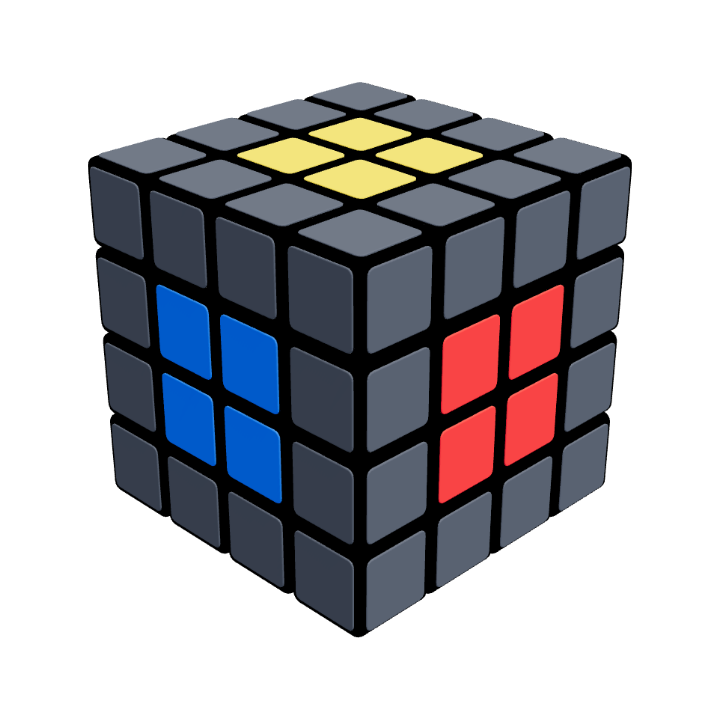
Your cube at this stage
Six centers complete
Each 2×2 center block is uniform and the colors are in the correct order. The edge wings still need pairing.
Confirm these on your cube. Watching the animation alone does not complete the lesson.
Check every item when you can do it yourself.