Any 3×3 cube. It can be scrambled.
Pick any face as the front. No moves to memorise yet.
1. Think in pieces, not stickers
A turn moves a whole piece. The two stickers on an edge always travel together; the three stickers on a corner also stay together. You cannot move just one sticker to a new face.
| Piece | How to recognise it | Where it belongs |
|---|---|---|
| Centre | One sticker, in the middle of a face | Defines that face’s colour |
| Edge | Two stickers, between two corners | Between the two matching centres |
| Corner | Three stickers, at a vertex | Between the three matching centres |
Find one of each on your cube before continuing. There are six centres, twelve edges, and eight corners.
2. Use the centres to work out where each piece belongs
Turn a face slowly. Its centre stays in the middle while the surrounding pieces move. On a 3×3, the centres keep the same positions relative to one another.
The white-blue edge belongs between the white and blue centres. A white-blue-red corner belongs between those three centres, even if its white sticker currently points sideways. Its position and the direction its stickers face are two different things to fix.
Our example cube has yellow on top, white underneath, blue in front, and red on the right. Your cube’s colours may be arranged differently; use its centres as your reference.
3. Understand the route to a solved cube
We will gather white edges into a daisy, line them up into a white cross, then insert the white corners. This completes the first layer. Next come the middle edges, yellow cross, yellow corner orientation, corner positions, and final edge positions.
Each stage protects the finished work from the earlier stages. Keep the same scramble as you move through the solving lessons. The next lesson starts where the previous one ends.
4. A face is not a layer
Four white corners with white facing down can still be in the wrong places. Look around the sides: a finished bottom layer has a matching bottom row on each side. We will check both white and the side colours before moving on.
Watch, then try
Work through an example
Start by stepping through the example one move at a time. This example demonstrates a specific action. Use the lesson’s setup instructions to recognise when that action applies to your own scramble.
Watch one worked example
Watch R followed by R′. The centre stays in the middle of the right face while whole edge and corner pieces move around it.
Example grip: yellow up · blue front · red right at the start. Follow any written whole-cube rotations.
0 / 2
Loading 3D cube…
Prepared position · 0 / 2 moves
Use Next move to follow the sequence.
Drag to inspect other faces. When the cube has focus, use the arrow keys to rotate the view.
Copy this exact example on your own cube
Start with a solved 3×3, with yellow on top and blue facing you. Follow the setup moves below from left to right to recreate the example’s starting position. Keep this example separate from the scramble you’re solving throughout the course.
R U R' F2 D L2 B U2Then follow the lesson sequence. If your cube has a different colour scheme, use your own colours to identify the corresponding pieces.
Compare the starting position and the result
Drag each cube to inspect its other faces.
Explain it to yourself
Check your understanding
Now use your own cube
Your turn
Find the white-blue edge and the white-blue-red corner on your cube. Trace every sticker on each piece, then point to the centres around the spot where that piece belongs.
Open a 3×3 Digital Cube for practiceThe Digital Cube opens in a new tab so you can keep this lesson open while you practise. Check for yourself whether you’ve met the lesson goal, as the Digital Cube doesn’t assess your result.
If you get stuck
My white face is solid, but the sides are mixed.
Some white pieces are in the wrong positions. Before moving on, match the other colours on every white piece to the side centres, even if the white face is already solid.
Before moving on
Check your result
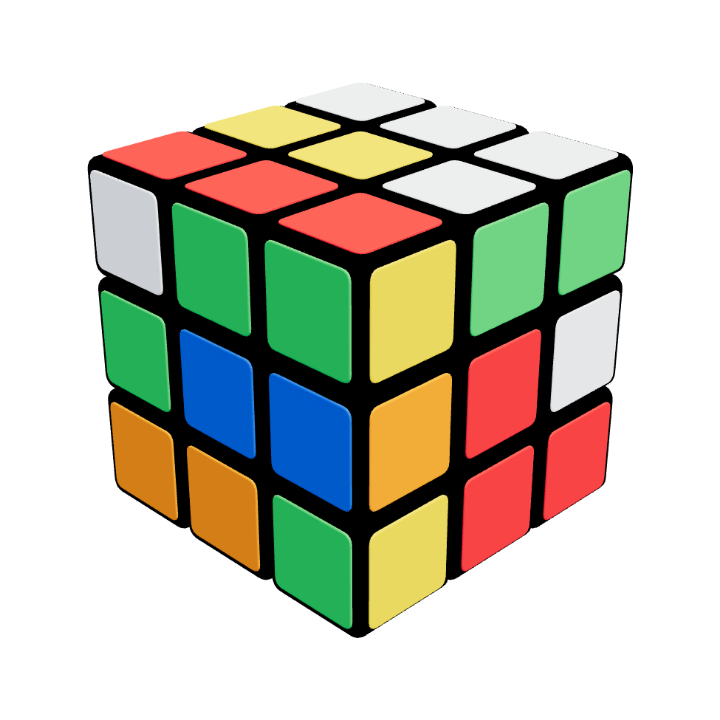
Preparation · no solving yet
Know the pieces
Find centres, edges and corners. This lesson is about recognising the pieces. Your cube can still be scrambled.
Confirm these on your cube. Watching the animation alone does not complete the lesson.
Tick each item when you can do it yourself.