Six solved centres and eleven fully matched three-piece edges.
Put the mismatched three-piece group at top-front (UF). Its midge is the reference.
1. Recognise the final wing mismatch
Eleven edges must already be complete. The last group may have both wings reversed relative to the midge: the outer two stickers match each other, but the middle sticker is the other edge colour. You see the opposite checkerboard on the other face.
This is a swap of the two wings, not a single sticker flipping in place. If several groups are still unpaired, return to ordinary pairing first.
2. Place that group at top-front
Rotate the whole cube to put the affected group at UF. Keep its midge as the orientation reference. Compare all three stickers on each of the two sides with the prepared starting net before beginning.
3. Use the 5×5 version exactly
Rw U2 x Rw U2 Rw U2 Rw' U2 Lw U2 3Rw' U2 Rw U2 Rw' U2 Rw'
Break it into these chunks:
Rw U2 xRw U2 Rw U2 Rw' U2Lw U2 3Rw' U2Rw U2 Rw' U2 Rw'
Rw and Lw turn two layers. The single 3Rw′ turns the rightmost three layers, and occurs after Lw U2. x rotates the whole cube like R; use the new directions after it. Complete the final Rw′ before inspecting.
4. Return to reduction checks
Every edge should now form two matching three-sticker bars, and all centre blocks should be solid. Reorient for the ordinary solve and proceed to the next lesson, which uses outer 3×3 moves.
A correctly reduced 5×5 has no additional 4×4-style last-layer OLL or PLL parity. If an apparent exception appears later, inspect your grouped edges rather than applying the 4×4 algorithms.
Need a reminder of the move notation?
R right · L left · U top · D bottom · F front · B back. A plain letter means a 90° clockwise turn as you look directly at that face. An apostrophe (′) reverses the turn. A 2 means a 180° turn. Keep the same face towards you throughout the algorithm.
Rw turns the rightmost two layers together. 2R turns only the second layer from the right. 3Rw turns three layers. x rotates the whole cube like R, so the old front becomes the new top.
Watch, then try
Work through an example
Start by stepping through the example one move at a time. This example demonstrates a specific action. Use the lesson’s setup instructions to recognise when that action applies to your own scramble.
Watch one worked example
The wings in the UF group do not match its midge. Watch for the single three-layer 3Rw′ after Lw U2. All other Rw moves use two layers.
Example grip: yellow up · blue front · red right at the start. Follow any written whole-cube rotations.
0 / 18
Loading 3D cube…
Prepared position · 0 / 18 moves
Use Next move to follow the sequence.
Drag to inspect other faces. When the cube has focus, use the arrow keys to rotate the view.
Copy this exact example on your own cube
Start with a solved 5×5, with yellow on top and blue at the front. Apply the setup below from left to right to create the example’s starting position. Keep this example separate from the scramble you’re solving throughout the course.
Rw U2 Rw U2 Rw' U2 3Rw U2 Lw' U2 Rw U2 Rw' U2 Rw' x' U2 Rw'Then follow the lesson sequence. If your cube has a different colour scheme, use your own colours to identify the corresponding pieces.
Compare the starting position and the result
Drag each cube to inspect its other faces.
Explain it to yourself
Check your understanding
Now use your own cube
Your turn
Compare the final group’s two wings with its midge on both faces. If it matches the parity case, perform the full 5×5 repair and recheck every edge group.
Open a 5×5 Digital Cube for practiceThe Digital Cube opens in a new tab so you can keep this lesson open while you practise. Check for yourself whether you’ve met the lesson goal, as the Digital Cube doesn’t assess your result.
If you get stuck
I used the 4×4 version and the final edge is still wrong.
The 5×5 sequence uses 3Rw′ in one place where the 4×4 version uses Rw′. Check that move and count three layers.
More than one edge is still incomplete.
Return to ordinary pairing. This case assumes eleven complete groups and only one reversed-wing group.
Before moving on
Check your result
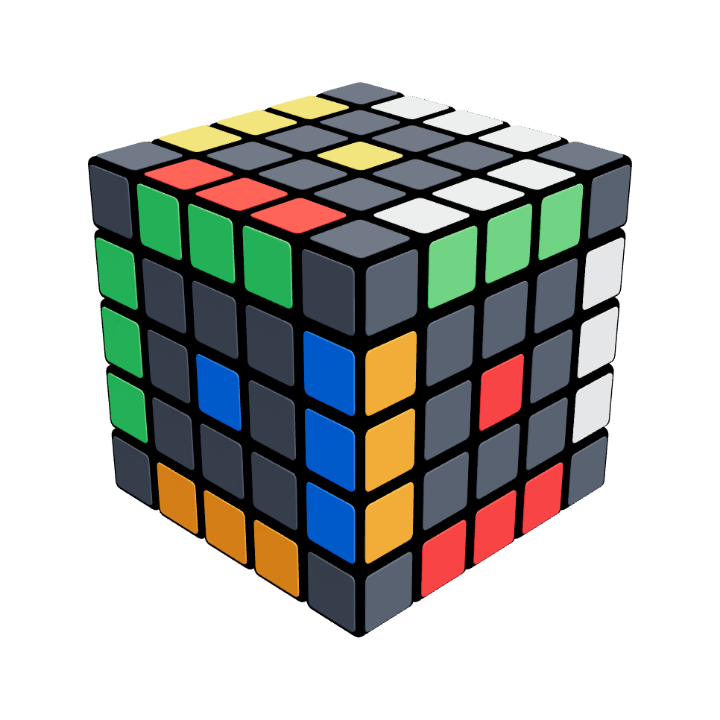
Your cube at this stage
All twelve edges complete
All three pieces of every edge match and the centres are intact. The groups can now be solved with outer 3×3 moves.
Confirm these on your cube. Watching the animation alone does not complete the lesson.
Tick each item when you can do it yourself.