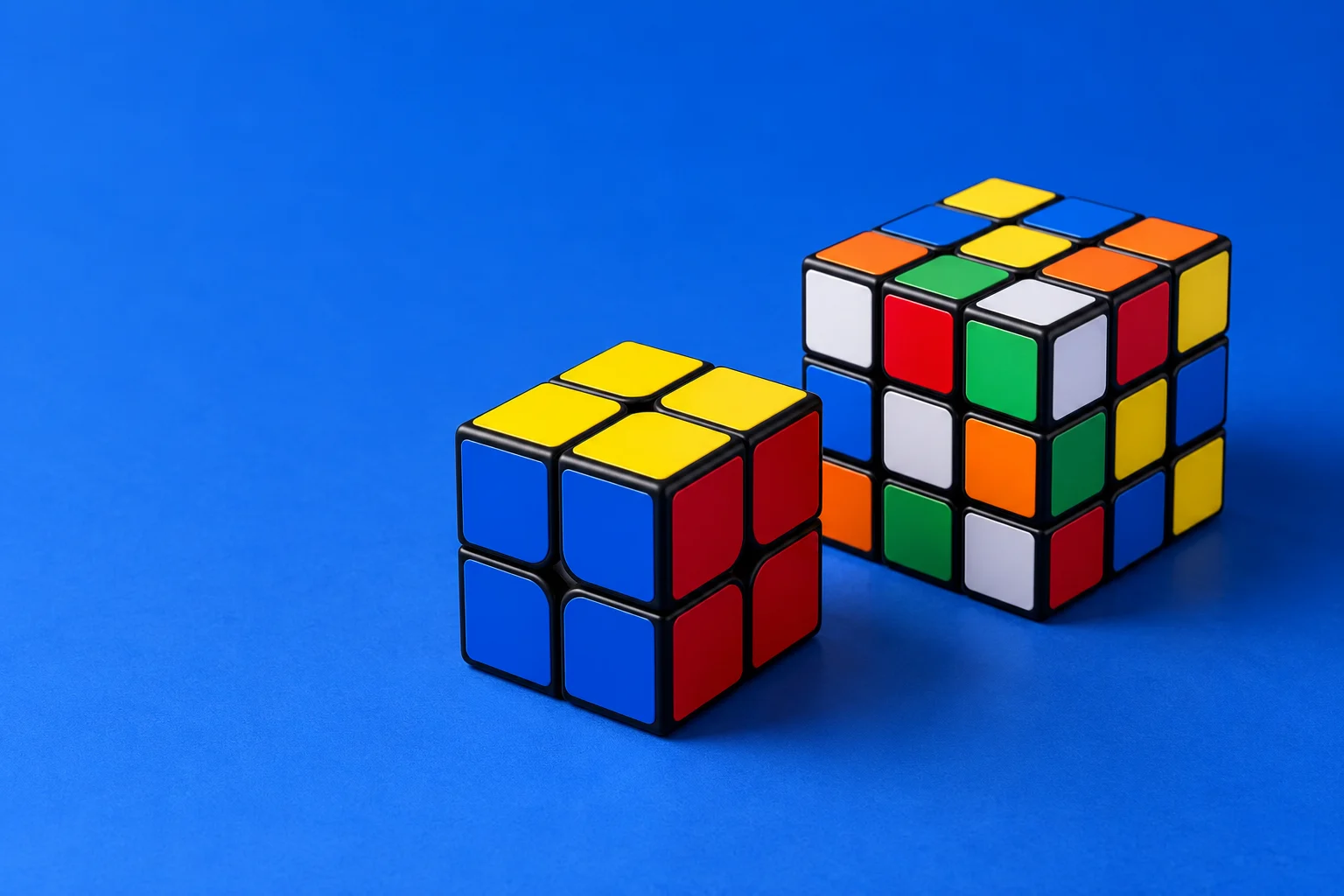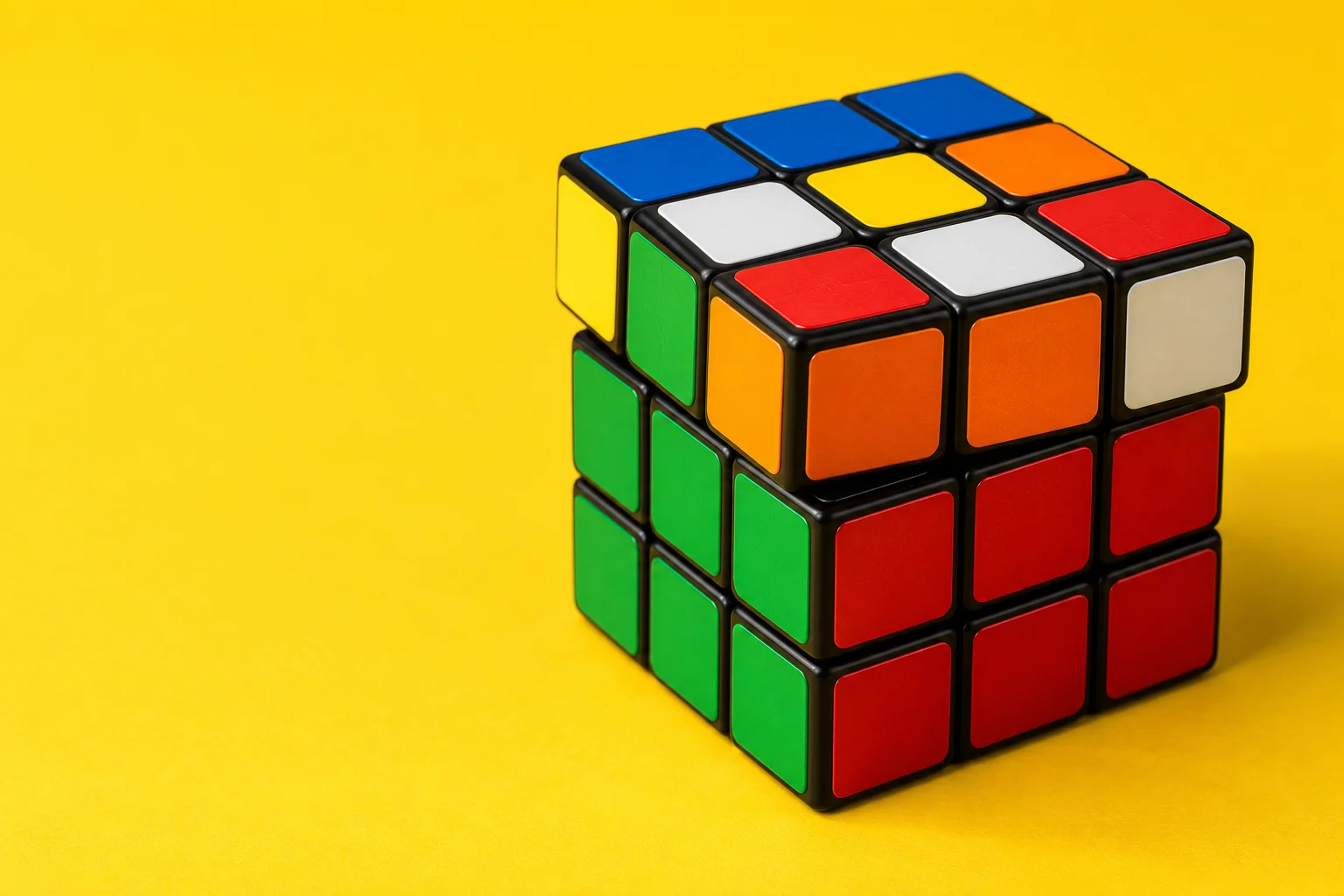
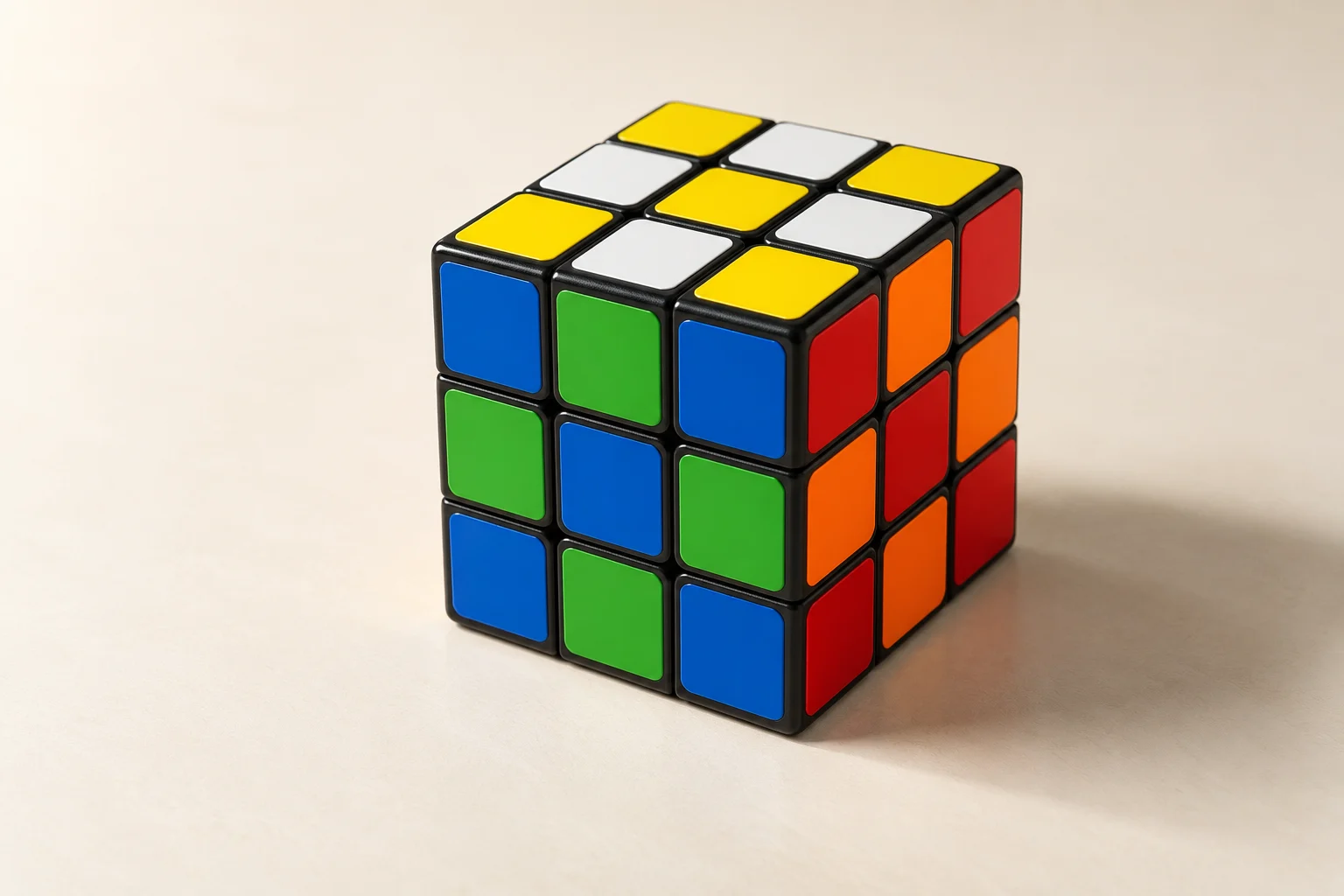
Start every pattern below with a solved 3×3 cube. Keep the same front face and top colour while following the sequence. Each linked pattern opens its exact notation and an interactive player, so you can stop at a difficult turn and inspect the other faces.
These patterns are for practice and are listed in no particular order of difficulty. Start with a short sequence whose result is easy to recognise, then explore the designs that interest you.
Fifteen patterns to try
- Checkerboard: compare alternating stickers across several faces. This is a useful first test of slice turns.
- Six Spots: inspect the centre of every face instead of checking only the three visible sides.
- Cube in a Cube: rotate the finished cube to see how the nested-cube illusion connects around a corner.
- Cube in a Cube in a Cube: follow the nested outlines and compare them with the simpler design above.
- Anaconda: trace the band as it crosses from one face to the next.
- Python: compare this connected design with Anaconda to help you remember more than its name.
- Black Mamba: watch the whole sequence before trying it from memory.
- Green Mamba: compare its arrangement with Black Mamba using the final-state previews.
- Four Spots: check which faces change and which ones preserve a larger solid area.
- Cross: inspect the arms of the cross and their surrounding corner colours.
- Four Crosses: count the finished faces and inspect the remaining two.
- Gift Box: follow the contrasting bands around the cube like ribbon.
- Spiral Pattern: inspect the result from several angles to see the repeating path.
- Vertical Stripes: compare the direction of the bands on adjacent faces.
- Superflip: all twelve edges are flipped while corners and centres stay in their solved positions. It is a legal 3×3 position, unlike a single flipped edge.
Read the turns before starting
A plain letter means a clockwise quarter-turn when looking directly at that face. A prime (') reverses the direction, and 2 makes a half-turn. M, E and S turn a middle slice. The notation reference explains their direction. Making a move changes the cube’s state. Changing your viewing angle leaves that state intact.
When using a physical cube, work on a stable surface and avoid forcing a misaligned layer. On the website, use Next move and Previous move to compare the cube immediately before and after a move. Use the final preview to check the completed pattern. For intermediate steps, refer to the state shown at that step.
Undo a pattern reliably
To undo any sequence, read its moves in reverse order and reverse each quarter-turn. Keep half-turns unchanged. For example, the inverse of R U F2 is F2 U' R'. Repeating the algorithm is an unreliable way to undo a pattern, as some patterns take several repetitions to return the cube to a solved state.
Reset returns the Digital Cube to a solved state. On a physical cube, reverse the sequence or use the solver if you lose your place. Leave the cube unscrambled before trying the pattern again, as these instructions require a solved starting state.
Explore other cube sizes
The pattern library includes designs and interactive playback for every size from 2×2 through 17×17. Select the correct size before following a sequence. An outer-turn algorithm on a 3×3 can produce a different design on a 4×4, and numbered inner-layer moves require enough layers. Each pattern includes its complete notation, a final reference image, and a Digital Cube link that opens the matching size.